en
en de
de Hefei Super Electronics Co., Ltd.
What Are You Looking For?

Many customers wonder whether placing two sintered NdFeB magnets together will create a stronger magnetic force. The short answer is yes—but only under certain conditions. Understanding how stacked magnets work can help you choose the right magnet configuration for your application while avoiding common misconceptions.
»» Does Stacking Two Magnets Make Them Stronger?
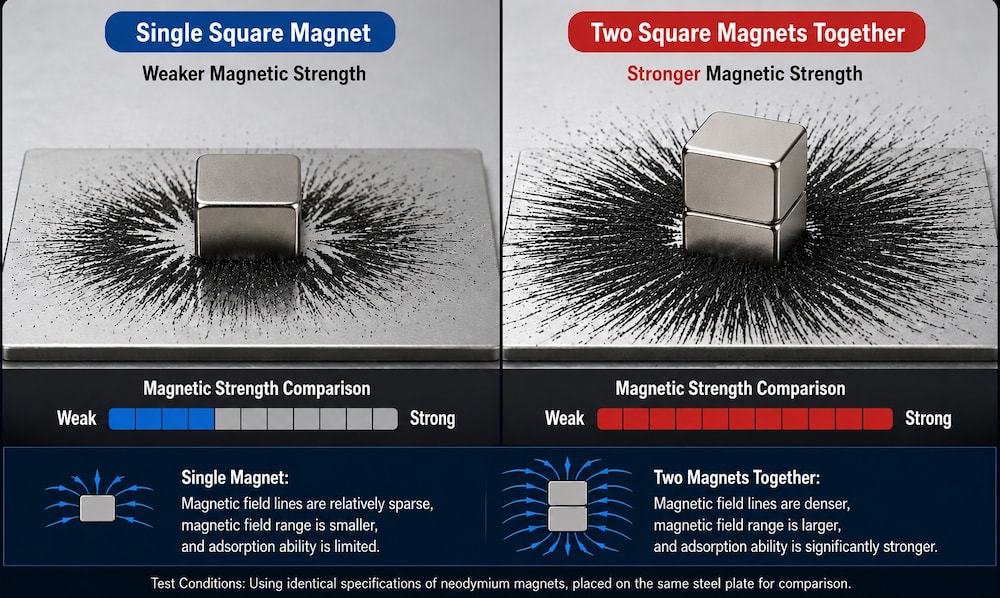
When two neodymium magnets of the same size, grade, and magnetization direction are stacked with opposite poles touching (North to South), they effectively behave like a single thicker magnet. Increasing the magnet's thickness allows more magnetic flux to reach the working surface, often resulting in a stronger holding force.
However, the increase is not always double. Magnetic performance depends on several factors, including magnet dimensions, air gaps, steel contact surfaces, and the magnetic circuit. In most practical applications, stacking magnets improves pull force, but the gain gradually decreases as additional magnets are added.
»» Why Does Magnetic Force Increase?
The magnetic field produced by a permanent magnet extends into the surrounding space. Thin neodymium magnets lose more magnetic flux through their sides, while thicker magnets utilize their magnetic material more efficiently.
By stacking two magnets:
√ The effective magnet thickness increases.
√ More magnetic flux is concentrated toward the working face.
√ The holding force on steel surfaces generally becomes stronger.
√ The magnetic field extends farther from the magnet surface.
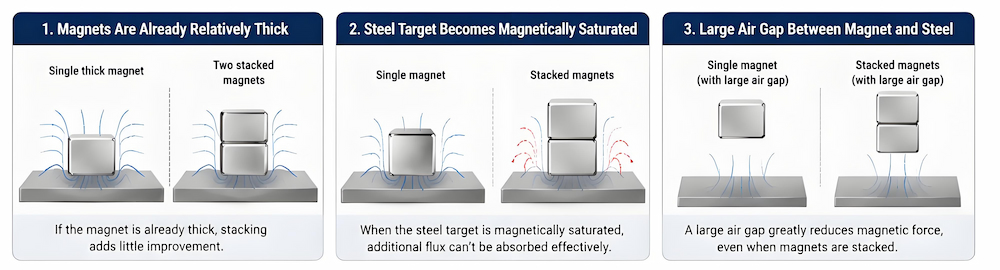
Although stacking magnets is an effective way to improve magnetic performance in many applications, there are situations where adding more magnets provides little or no additional benefit. Understanding these limitations helps engineers and buyers choose the most efficient magnetic solution.
1.Magnet is already thick enough, it reaches a point where additional thickness contributes very little to the magnetic field at the surface, because most of the magnetic flux is already fully utilized.
2.Steel can only carry a limited amount of magnetic flux before becoming magnetically saturated. Once saturation occurs, additional magnetic flux from stacked magnets cannot effectively pass through the steel. As a result, the holding force increases only slightly, even though more magnets have been added.
3.Magnetic force decreases extremely quickly as the distance between the magnet and the object increases.
If paint, plastic, wood, rubber, adhesive tape, or other non-magnetic materials create an air gap, stacking magnets May provide only a small improvement because much of the magnetic field is lost before reaching the target.
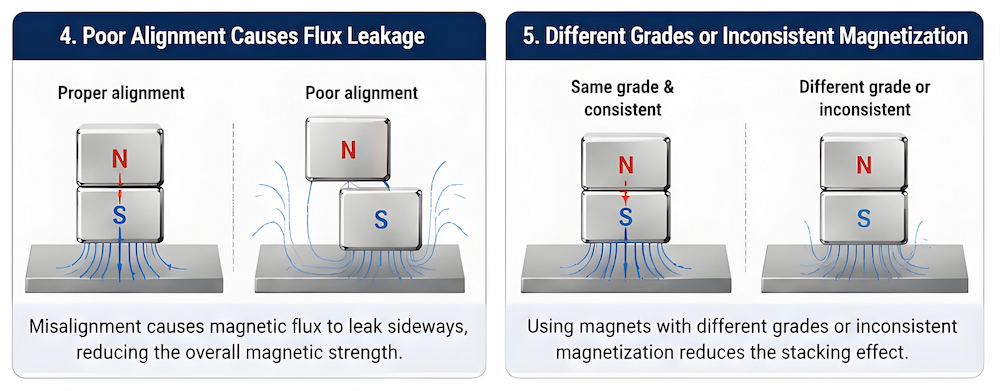
4.If the magnets are even slightly misaligned, part of the magnetic field spreads outward through the sides instead of being directed toward the target. This phenomenon, known as magnetic flux leakage, reduces the efficiency of the magnetic circuit. Instead of working together as one thicker magnet, the stacked magnets lose some of their combined performance because the magnetic energy is no longer concentrated where it is needed.
Misalignment can also create an uneven magnetic field, making the holding force less stable across the contact surface. In precision applications, even a small offset between stacked magnets can noticeably reduce overall magnetic performance.
5.Magnets with different grades generate different magnetic field strengths. When stacked together, the weaker magnet limits the overall performance, preventing the magnetic field from being distributed evenly throughout the assembly. Instead of producing a balanced and concentrated magnetic field, the combined magnetic flux becomes uneven, reducing the effectiveness of the stack.
The magnetization direction is equally important. Each magnet is designed so its magnetic field follows a specific orientation. If stacked magnets have different magnetization directions, their magnetic fields no longer reinforce one another effectively. Part of the magnetic energy May spread in unwanted directions rather than being focused toward the working surface, resulting in lower holding force and a less efficient magnetic circuit.
In addition, inconsistent magnetic properties can create an unstable magnetic field distribution, making the performance of the assembled magnets less predictable, especially in applications that require reliable and repeatable magnetic force.



 IPv6 network supported
Hi! Click one of our members below to chat on