en
en de
de Hefei Super Electronics Co., Ltd.
What Are You Looking For?

Neodymium magnets, also known as NdFeB magnets, are widely used in motors, sensors, speakers, generators, automation equipment, and many other industrial applications due to their excellent magnetic performance. When selecting the right magnet grade, customers often focus on terms such as Br, Hcb, and Hcj. These three parameters are important indicators that determine the strength, stability, and working performance of permanent neodymium magnets.

Understanding the meaning of remanence (Br), coercive force (Hcb), and intrinsic coercive force (Hcj) can help engineers choose the most suitable neodymium magnet for their applications.
What Is Remanence (Br)?
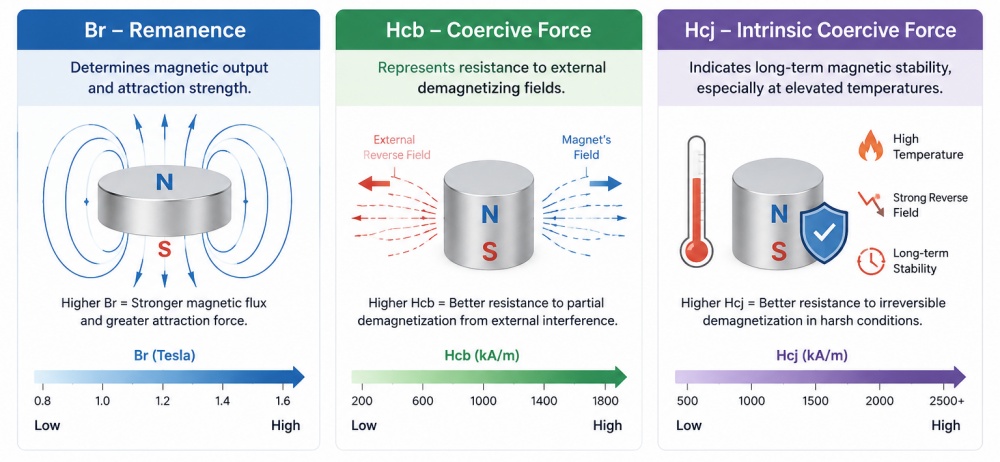
Remanence (Br) refers to the magnetic flux density remaining inside a magnet after the magnet has been fully magnetized and the external magnetic field is removed. It represents how much magnetic energy a magnet can maintain under a closed magnetic circuit condition. Simply speaking, Br indicates the magnetic strength of the magnet itself. A higher Br value means the magnet can produce stronger magnetic flux, which usually results in stronger attraction force.
For example, higher-grade neodymium magnets such as N42, N48, and N52 generally have higher remanence values compared with lower grades. These high performance magnets are commonly used in applications where strong magnetic output and compact size are required, such as brushless motors, magnetic couplings, and precision devices.
However, Br is not the only factor that determines magnet performance. A magnet with high Br but poor resistance to demagnetization may not perform well in high-temperature or harsh environments.
What Is Coercive Force (Hcb)?
Coercive force (Hcb) is the external magnetic field strength required to reduce the magnet’s magnetic flux density to zero after the magnet has been magnetized. Hcb reflects the magnet’s ability to resist external demagnetizing forces. A higher Hcb value means the magnet is more difficult to partially demagnetize when exposed to reverse magnetic fields.
In practical applications, magnets may experience magnetic interference, mechanical stress, or surrounding magnetic fields that can affect their performance. Therefore, sufficient Hcb is important to ensure stable operation.
What Is Intrinsic Coercive Force (Hcj)?
Intrinsic coercive force (Hcj) measures the ability of the magnetic material itself to resist demagnetization. Unlike Hcb, which considers the magnetic flux density, Hcj focuses on the internal magnetization of the material. Hcj is especially important for applications involving high temperatures or strong reverse magnetic fields. A higher Hcj value means the magnet has better resistance against irreversible demagnetization.
For example, high temperature resistant neodymium magnets containing heavy rare earth elements such as dysprosium (Dy) or terbium (Tb) usually have enhanced Hcj performance, allowing them to maintain stable magnetic properties in demanding environments.



 IPv6 network supported
Hi! Click one of our members below to chat on