en
en de
de Hefei Super Electronics Co., Ltd.
What Are You Looking For?

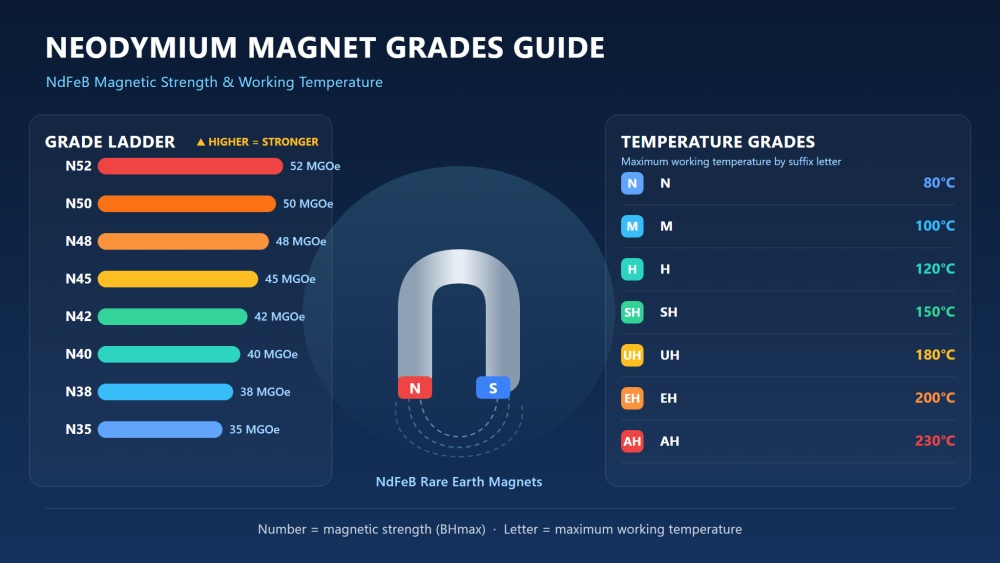
Neodymium iron boron magnets are known for their high magnetic strength, compact size, and excellent performance. However, choosing the right NdFeB magnet grade is essential to ensure reliable performance and cost efficiency. With grades ranging from N35 to N52 and high-temperature grades such as N35H, N42SH, and N38UH, how do you know which magnet is right for your application?
The first number in an NdFeB magnet grade, such as N35, N42, or N52, primarily indicates its maximum energy product (BHmax), which is related to the magnet's magnetic performance. Generally, a higher number means a stronger magnet when comparing magnets of the same size and shape.
Temperature is another important factor when selecting sintered NdFeB magnet. Standard grades are typically suitable for applications operating at relatively moderate temperatures. If the magnet will be exposed to elevated temperatures, high-temperature grade may be necessary.
Grades with suffixes such as H, SH, UH, EH, and AH are designed for improved resistance to demagnetization at higher operating temperatures.
Consider The Required Magnetic Force
Magnetic grade alone does not determine the actual holding force of a magnet. Before selecting NdFeB magnet, first identify how much magnetic force your application actually requires.
Consider the following factors:
• Load weight: How much weight does the magnet need to hold or support?
• Magnet size and shape: Increasing the diameter, thickness, or contact area can improve holding force without necessarily using a higher grade.
• Magnetization direction: The direction of magnetization should match the way the magnetic force is required in the application.
• Contact surface: A full, flat contact usually provides stronger holding force than a curved or uneven surface.
For example, if an N35 Neodymium magnet does not provide enough holding force, you do not necessarily need to upgrade directly to N52. Increasing the magnet's size or thickness may provide the required force more economically.
For applications such as magnetic fixtures, cabinet closures, sensors, lifting devices, advertising displays, and mounting systems, we recommend determining the required pull force first and then selecting the appropriate magnet grade and dimensions.
Balance Performance And Cost
A higher NdFeB grade does not always mean a better or more cost-effective solution. The right choice is the lowest grade that can reliably meet your application's requirements.
On the other hand, when installation space is limited and a strong magnetic force is required, a higher grade such as N48, N50, or N52 can allow you to achieve the required performance with a smaller magnet.
When comparing different solutions, consider:
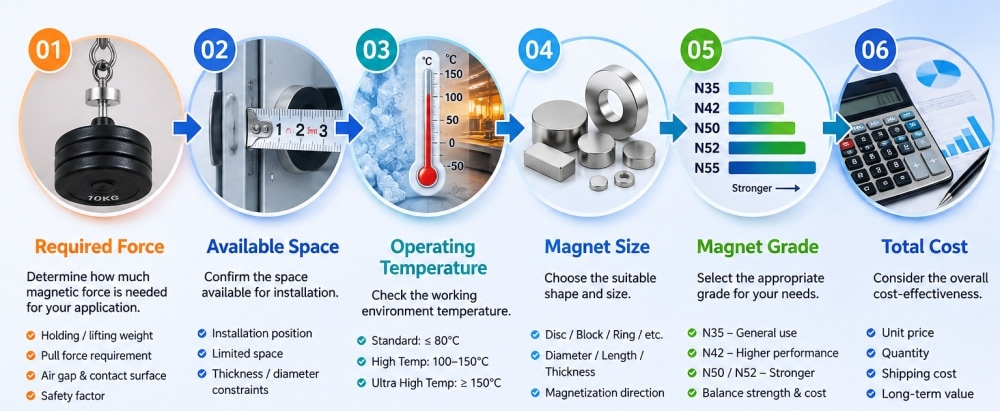
The most economical solution is not necessarily the magnet with the lowest price per piece. A properly selected magnet can reduce the required quantity, installation space, and replacement costs while maintaining reliable performance.
Selecting an neodymium magnet grade should be based on your complete application requirements, including magnetic force, operating temperature, available space, magnet size, and cost. The highest grade is not always the best choice—the right grade is the one that provides reliable performance at reasonable cost.
Not sure which NdFeB magnet grade is right for your application? We can provide samples for testing, allowing you to verify magnetic performance, size, coating, and fit in your actual application before placing a bulk order.



 IPv6 network supported
Hi! Click one of our members below to chat on