en
en de
de Hefei Super Electronics Co., Ltd.
What Are You Looking For?

Automation equipment relies on precise, reliable, and compact components to improve production efficiency and reduce manual operations. Among these components, sintered NdFeB magnets are widely used because of their high magnetic strength, compact size, and excellent holding performance. They are suitable for a wide range of industrial automation applications.
They can be used for positioning, holding, lifting, sensing, fixing, and separation in automated production lines. Compared with larger conventional magnets, NdFeB magnets can provide the required magnetic force while helping engineers maintain a compact equipment design.
Common Applications
Neodymium magnets are commonly used in different types of automation equipment, including:
Robotic arms and grippers: Magnets can help hold and transfer metal components during automated handling.
Conveyor systems: Magnetic components can assist with positioning, fixing, or separating metal parts.
Automated assembly machines: Magnets can temporarily hold components in the correct position during assembly.
Sensors and switches: Small NdFeB magnets are often used to trigger magnetic sensors for position detection.
Packaging equipment: Magnets can help with product positioning, material handling, and fixture systems.
Industrial fixtures: Pot magnets, block magnets, and countersunk hole magnets can provide convenient and secure mounting solutions.
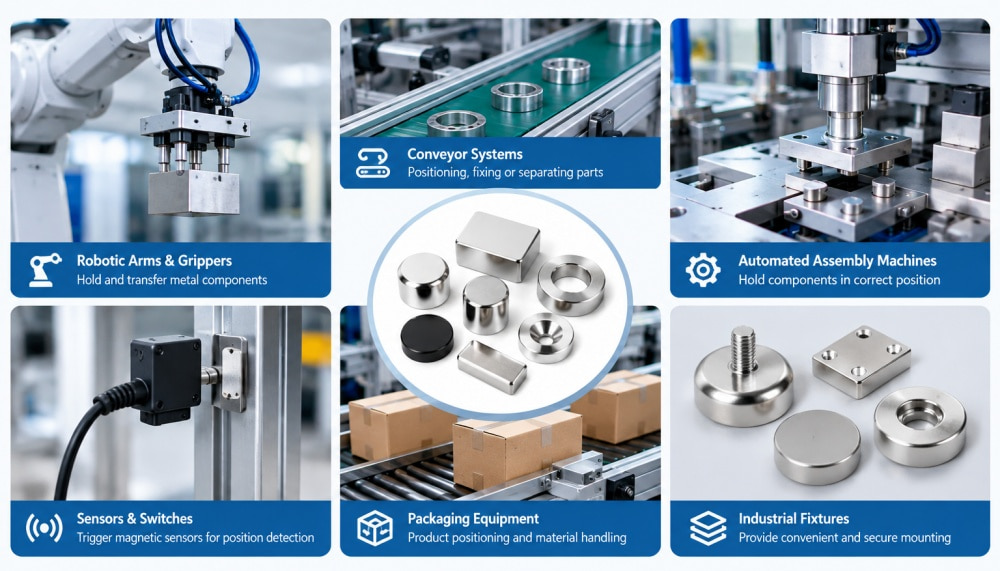
Choosing the right magnet for automation equipment involves more than picking the strongest grade. Engineers should consider magnetic force, installation space, operating temperature, size and shape, coating, and working environment. Shape also matters. The magnet's shape is also important. Block, disc, ring, countersunk, and pot magnets can be selected according to the installation method and required magnetic performance.
Automation equipment often requires magnets with specific dimensions, tolerances, coatings, magnetic directions, or mounting features. Custom neodymium magnets can be manufactured according to drawings, samples, or technical requirements.
For automation projects, testing a magnet before mass production can help reduce design risks and avoid unnecessary production costs. We can provide samples for testing, allowing customers to verify the design and performance in their actual equipment before placing a larger order.
Choosing the right neodymium magnet can help improve the reliability, efficiency, and flexibility of automated equipment while supporting more compact industrial designs.



 IPv6 network supported
Hi! Click one of our members below to chat on