en
 de
 Hefei Super Electronics Co., Ltd.
What Are You Looking For?

Sintered Neodymium Iron Boron magnets are widely recognized for their exceptional magnetic strength and high energy product. However, many engineers and buyers have noticed an interesting phenomenon: higher-grade NdFeB magnets are often more brittle and prone to chipping or cracking. Why does this happen?
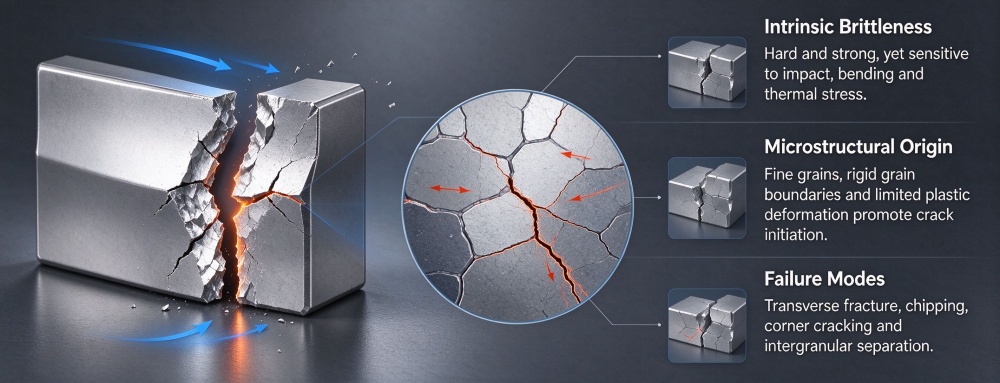
The Root Cause: Grain Boundary Engineering
Sintered NdFeB is inherently brittle, behaving structurally more like a ceramic than a metal. Its fracture is predominantly intergranular, meaning cracks propagate along the boundaries between the main magnetic grains. In higher-grade magnets—particularly those designed for elevated-temperature applications—dysprosium (Dy) is added to boost coercivity. Through processes such as two-stage aging or grain boundary diffusion, the Nd-rich grain boundary phase transforms into a continuous, uniform thin film that completely separates adjacent (Nd,Dy)₂Fe₁₄B grains.
This microstructural change is precisely what enhances magnetic isolation and coercivity. However, it simultaneously weakens the interfacial bonding between grains. The continuous boundary film acts as a preferential path for crack propagation, reducing the energy required for fractures to initiate and spread.
Quantifying the Brittleness Increase
Experimental data confirms this trade-off. In acoustic emission indentation tests, two-stage aged Dy-doped magnets exhibit a steeper slope in acoustic emission energy versus load (2.81) compared to as-sintered samples (1.94), indicating that cracks nucleate and propagate more readily. The total surface crack length also grows faster with increasing load in aged magnets, with the crack-length-versus-load slope rising from 1.25 for sintered samples to 2.00 for aged ones. These results clearly demonstrate that the aging treatment that boosts magnetic grade also increases brittleness.
Manufacturing Conditions
Grain Size and Microstructure: Fine and uniform grains are essential for achieving high coercivity and stable magnetic performance. However, grain boundary characteristics and weak intergranular bonding can influence crack initiation and propagation.
Sintering Temperature and Time: Improper sintering conditions may lead to abnormal grain growth, uneven grain boundary distribution, or residual porosity. These microstructural defects can reduce mechanical reliability.
Density and Internal Defects: Although high density generally improves material integrity, internal pores, microcracks, and uneven densification can create stress concentration points, making high grade NdFeB magnets more susceptible to fracture.
Composition and Process Optimization: Higher grade magnets require careful control of rare earth content and alloy composition. Changes in these parameters may affect both magnetic properties and mechanical behavior.
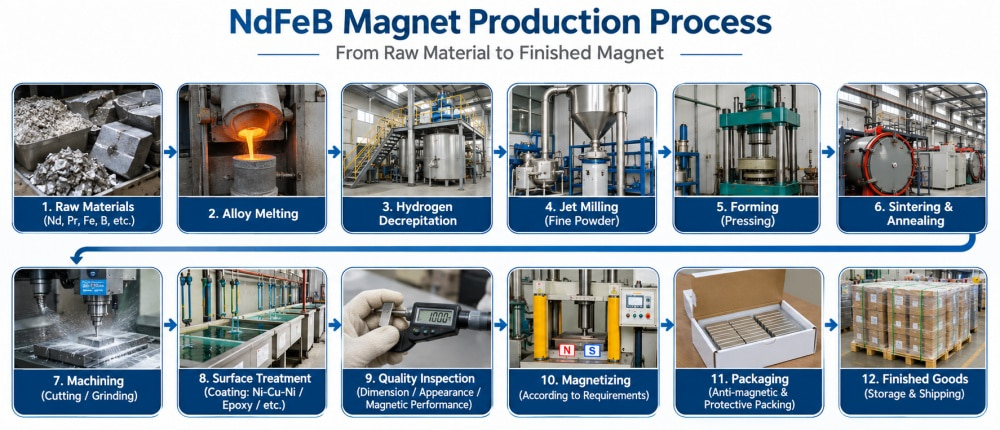
Higher-grade sintered NdFeB magnets provide outstanding magnetic performance, but their mechanical limitations should not be overlooked. Choosing the right NdFeB magnet grade requires balancing magnetic performance, mechanical requirements, and application conditions.
Working with an experienced NdFeB magnet manufacturer can help ensure the right combination of magnetic properties, dimensional accuracy, and product reliability for your application.



 IPv6 network supported
Hi! Click one of our members below to chat on